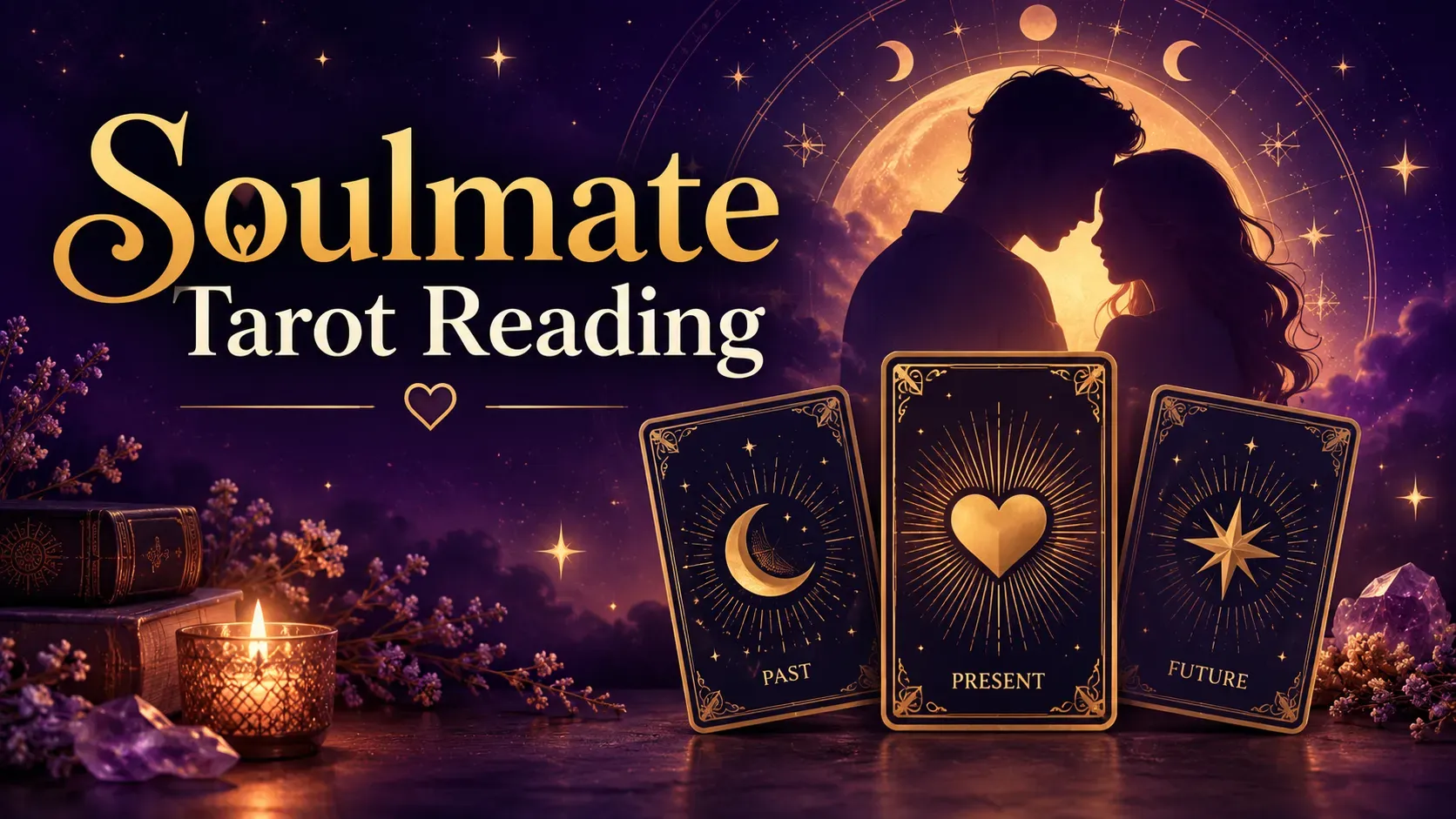
Soulmate Tarot Reading is a digital tarot love-reading experience built around a past-present-future card spread. This guide walks through the entire process, what each card position generally means, and how to get more from your reading.
Whether you're brand new to tarot or just want a complete walkthrough of this specific format before you try it, this page is designed as the most complete reference on the site, covering the mechanics, general tarot literacy around card positions, and how this format compares to other spreads.
No prior tarot experience is needed to follow along.
Start Your ReadingA Soulmate Tarot Reading is a digital love-focused tarot experience that uses a three-card past-present-future spread to prompt reflection on your romantic patterns and relationships.
It begins with a free, interactive card-picking step where you choose three cards yourself, guided by your own intuition rather than a fixed algorithm assigning you a message. That free step can then lead into a more detailed, paid personalized reading, though the depth and exact format of that paid tier is reported by independent reviewers rather than confirmed on the official domain itself.
This guide focuses on the confirmed mechanics of the process and general tarot literacy around card positions. It is meant as an educational reference, not a claim about specific card meanings unique to this vendor's proprietary system.
The process moves through five stages, from opening the page to receiving your finished reading.
For a page focused specifically on the free portion of this process, including exactly what's included at no cost, see our Soulmate Tarot Reading free access guide.
Do you need to finish the reading in one sitting? The official page doesn't publish details on saved sessions, so it's safest to plan for a few uninterrupted minutes to complete the free spread in one visit.
A short bit of preparation makes the whole process feel more purposeful. You don't need any special ritual, just a few minutes of focus.
Find a moment when you won't be interrupted, since the interactive card layout works best with your full attention rather than split across a busy multitasking moment. Take a breath and think honestly about what's actually on your mind regarding your romantic life right now: a recent pattern, a specific relationship, or a decision you've been putting off. You don't need to write anything down, though some readers find that jotting a one-line question beforehand helps them stay focused once the cards are drawn.
None of this preparation is required by the offer itself. It's simply a practical habit that tends to make any reflective exercise, tarot or otherwise, more useful.
In traditional 78-card tarot decks, cards are divided into two broad categories: the 22 Major Arcana cards, generally associated with significant life themes, and the 56 Minor Arcana cards, generally associated with day-to-day events and emotions.
This is general tarot literacy that applies across the wider practice, not a claim specific to any one vendor's proprietary system. Major Arcana cards (such as The Fool, The Lovers, or The Wheel of Fortune) are traditionally read as pointing to bigger, more transformative themes, while Minor Arcana cards, divided into four suits similar to a standard card deck, are traditionally read as reflecting smaller, more immediate circumstances.
Whether a specific reading draws from the full 78-card deck or a smaller curated set isn't something we can confirm for every digital offer in this category, including this one , but understanding this general distinction can help you interpret whatever cards you do see with a bit more context.
You don't need to memorize any of this to use the free spread. The point of covering it here is purely educational, so that if you go on to explore tarot more broadly after this reading, you'll already have a basic vocabulary for how the practice is generally structured.
In general tarot practice, the "past" position in a three-card spread represents influences, patterns, or experiences that have shaped your current situation.
This is standard, widely taught tarot literacy, not a claim specific to this vendor's system. In a love-focused spread, the past card is typically read as a lens on a relationship pattern, past decision, or emotional habit that set the stage for where you are now. The idea is not that the card describes one literal past event, but that it points toward a theme worth acknowledging before moving forward.
When reflecting on your own past card, consider: does the general theme resonate with a real pattern in your relationship history? That question is often more useful than trying to match the card to one exact memory.
Some readers find it helpful to think of the past card as answering "what set the stage" rather than "what specific thing happened." A card pointing toward a theme of independence, for example, might reflect a broader pattern of valuing self-reliance in past relationships, rather than describing one particular event you can pinpoint on a calendar.
The "present" position generally reflects your current emotional state or the active dynamics at play in your romantic life right now.
In traditional three-card layouts, this middle position often carries the most emphasis, since it anchors the "past" and "future" cards to your actual present-day situation. For a love-focused reading, this could touch on how you're currently feeling about a relationship, a decision you're weighing, or a pattern that's actively showing up.
A useful way to engage with the present card is to ask yourself honestly: is this theme something I'm already aware of, or does it surface something I hadn't consciously named yet? Either answer is a valid, useful outcome of the reflection.
In standard tarot literacy, the "future" position represents a likely direction or outcome IF current patterns continue, not a fixed, unavoidable event.
This distinction matters. A reflective reading treats the future card as a prompt ("here's where this pattern seems to be heading") rather than a guarantee ("this will definitely happen"). Soulmate Tarot Reading is framed around this kind of reflective approach rather than presenting fixed predictions, and that is the honest, responsible way any legitimate tarot-style product in this category should be framed.
If your future card feels uncomfortable, remember that the entire premise of a reflective reading is that patterns are things you can notice and potentially change, not sealed outcomes.
A handful of simple habits make a real difference in how useful a tarot reading feels.
For an honest discussion of the limits of any tarot reading's "accuracy," see our dedicated page on how accurate a free soulmate reading online can really be. It's essential reading before you put too much weight on any single result.
The past-present-future format sits in the middle of tarot complexity: more structured than a single-card draw, simpler than a full deck reading.
| Format | Single-Card Draw | Past-Present-Future (3 Cards) | Full 78-Card Deck Reading |
|---|---|---|---|
| Complexity | Lowest | Moderate | Highest |
| Time to Complete | Under a minute | A few minutes | 30+ minutes, often with a reader |
| Narrative Structure | None, one theme only | Clear arc: past, present, future | Complex, multi-layered |
| Beginner Friendly | Usually requires a trained reader | ||
| Best For | A quick daily check-in | A focused relationship question | Deep, multi-area life exploration |
If you want the simplicity of a quick daily pull, a single card is faster. If you want a full, multi-area life reading, a trained tarot reader working a larger spread goes deeper. The three-card past-present-future format is a practical middle ground: structured enough to give a narrative, simple enough for a complete beginner to follow without training.
There's no universally "correct" format to choose; it depends on what you're looking for in the moment. Someone wanting a quick daily mood check might prefer a single card. Someone working through a specific, ongoing relationship question might get more out of the structured past-present-future arc. Someone wanting a comprehensive, multi-topic life reading would generally look toward a trained reader working a larger, full-deck spread rather than a free digital front end like this one.
No. No tarot reading, from this product or any other, can be verified as 100% accurate, and any product that claims otherwise should be treated with skepticism.
Soulmate Tarot Reading is explicitly framed as entertainment, with an 18+ disclaimer confirmed directly on the official landing page. The value of a reading like this comes from the reflection it prompts, not from a factual guarantee about your romantic future. We cover this distinction in much more depth, including how to interpret results responsibly, on our dedicated accuracy and personalization page.
Should you treat your reading result as certain? No. Treat it as one perspective worth considering alongside your own judgment, not as a guaranteed outcome.
This guide is written for anyone who wants the full picture before starting, not just the quick version.
For real reader reactions to the experience, see our full Soulmate Tarot Reading review, or head back to our homepage for the complete overview of the offer.
However you arrived at this guide, whether from general curiosity about tarot, a specific relationship question, or comparison-shopping between digital reading formats, the goal of this walkthrough has been the same: give you a complete, honest picture of the process before you spend a single minute on the actual card spread, so nothing about the experience catches you off guard.
Free entry spread • Fully digital • ClickBank standard guarantee†
Yes. This walkthrough is written for first-time visitors and explains the process, the general meaning of each card position, and practical tips in plain language, so you do not need any prior background in tarot to follow along and try the reading yourself.
A specific, open-ended question about a real situation tends to work better than a vague one. For example, reflecting on "what pattern keeps showing up in my relationships" gives you more to work with than a generic question like "will I find love," since the reading is built for reflection rather than a yes-or-no answer.
For a full breakdown of exactly what the free card spread includes and where the paid option begins, see our dedicated page on Soulmate Tarot Reading free access, which walks through the step-by-step process in detail.
The confirmed entry-point spread uses three cards, laid out to represent your past, present, and future in a romantic context. This is different from larger traditional tarot layouts, which can use ten or more cards in a single session.
No. The past-present-future format is designed so that the interpretation is presented to you after you choose your cards, so no prior tarot knowledge is required. This guide also covers general card-position meanings so you can follow along even as a complete beginner.
There is no official guidance published by the vendor on how often to repeat a reading. As a general practice with reflective tools like this, many people wait until their circumstances meaningfully change before returning for a fresh perspective, rather than repeating it daily.
A three-card spread, like the past-present-future format used here, focuses on a single narrow question using just three cards, making it faster and easier to interpret. A full 78-card tarot deck reading typically involves a trained reader working through a much larger, more complex layout, which takes longer and generally goes deeper into multiple areas of life at once.
Yes, in general tarot practice, a three-card past-present-future spread is one of the most common introductory layouts used across many tarot traditions, not something unique to this product. It is popular precisely because it is simple to follow while still giving a sense of narrative structure.
Author: Soulmate Tarot Reading Editorial Team
This guide combines a direct review of the official Soulmate Tarot Reading landing page with general, widely taught tarot literacy about card-position meanings. This page contains affiliate links, and if you purchase through our links we may receive compensation at no additional cost to you. Last updated September 8, 2026.